I Built Eight Things to See If AI Changed the Rules. The GTM Gap I Thought Was Permanent Started Closing Anyway.
Eight side properties as a curriculum, not a strategic portfolio. The GTM gap I'd lived with for fifteen years is closing, using the same AI-leverage that built the eight things in the first place.

When I sat down a while back to articulate my thesis for this notebook, I told a chatbot that GTM was the consistent gap across the eight things I run on the side. I said I could build things with AI. I said I could rebuild a family business. I said I could ship an iOS app. I said I could maintain a real B2B SaaS company solo. And I said I had never been great at selling, and that the gap was still there, after eight tries.
I was honest with the chatbot. I was prepared to live with the gap as a permanent feature.
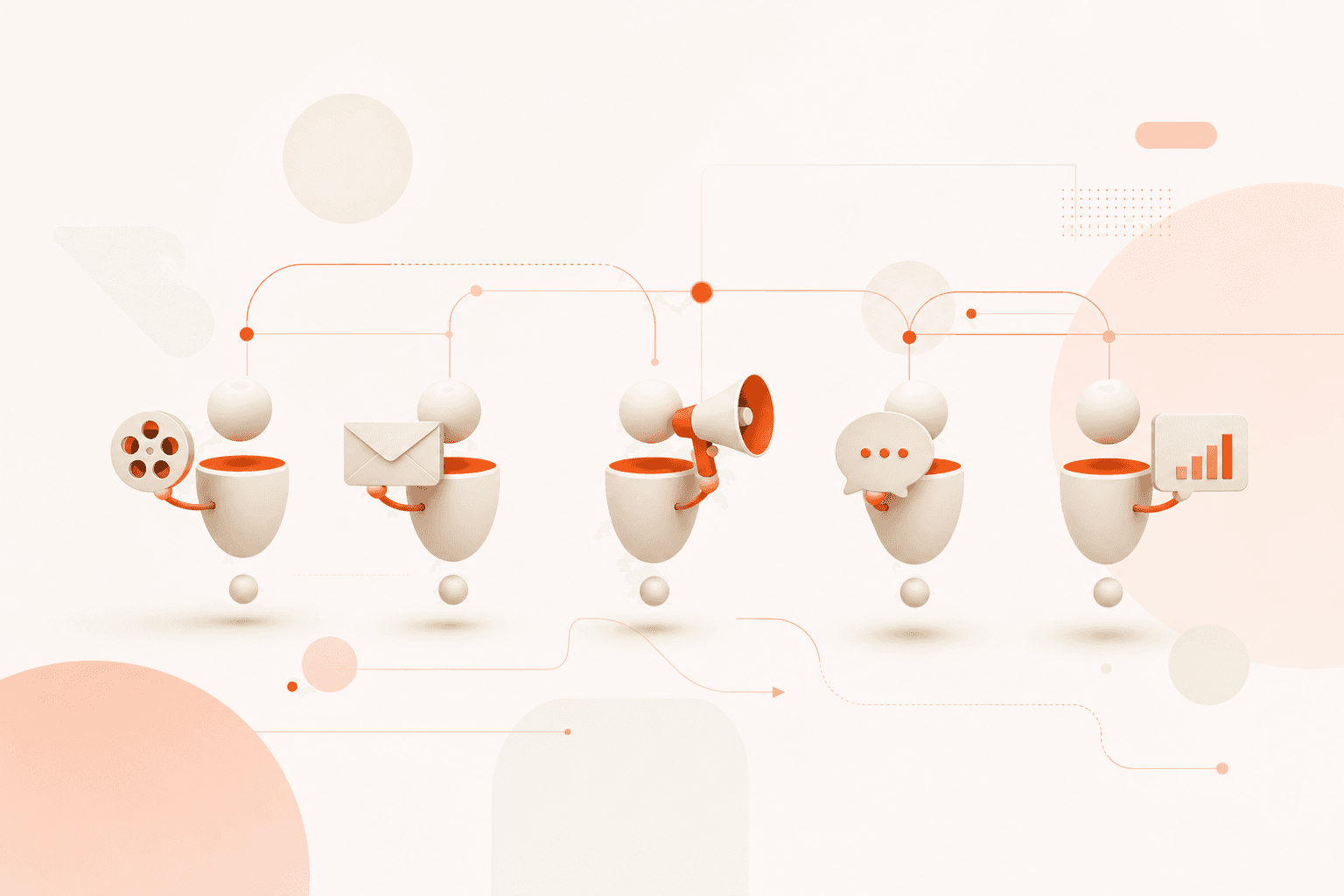
I have not lived with it. The Meta ads on Gramms are now generated by a Claude agent that proposes creatives, targeting, and bid adjustments off the previous day's performance. The agent posts a recommendation; I approve or override; the campaign runs. The marketing videos for the same product are being generated by a pipeline that drafts a script, generates the visuals, animates them with Higgsfield, voices them with ElevenLabs and Cartesia, and schedules the post across X, Instagram, TikTok, and YouTube through Upload-Post. The cold-outreach to parenting-niche journalists, podcasters, and influencers is being run by an agent that researches each target through Apollo and Hunter, finds the right contact, validates the email, drafts a personalized pitch in my voice, and sends it. The DM-based equivalent uses Perplexity to find the social handles of the same influencers, follows them on the right platforms, drafts the DM, and engages. None of these existed when I told the chatbot the gap was permanent.
The gap is not closed. It is narrower than it was, and it is narrowing faster than I expected. The mechanism that closed the distance is the same mechanism that built the eight things in the first place. Which is itself the case study.
The eight things, in plain language
I am going to walk through the eight properties the way I would walk a friend through them at coffee, because the per-property elevator-pitch posture would not be honest. Each one tested an AI now makes X possible claim. Some of the claims survived. Some did not.
Audio2TextPro tested whether a non-technical person could build a production-grade end-to-end SaaS product with a website that did not look unpolished, free trial, authentication, freemium, payments, the whole stack. The answer was yes. The product itself is not a real business, and the domain is now closest-to-dead in my portfolio. I keep it because the cost is essentially zero and the proof is durable.
RoastMasterRick extended the claim past web app into Chrome extension territory. Different surface. Different review process. Different paywall mechanics. The answer was yes again. It is small. It works.
Snaplife tested whether AI could be under the hood, not just the thing that built the product. Still images become videos with synchronized audio through a pipeline that stitches together several model providers under the hood. The proof of the claim showed up in the free-tool pages, which are quietly the strongest organic surface in the whole portfolio.
Mark IT is the family Tally partner business in Mumbai, started by my mother in 1999, run by my brother now. It tested whether a single operator with AI could replace an external web team and an SEO agency that had been costing us hundreds of dollars a month and delivering thousands of monthly visitors. About ten hours of weekend work, three and a half months, three thousand visitors went to sixteen thousand. The agencies were fired. The claim survived strongly. The flip side I am watching now is that a meaningful share of the traffic to Mark IT is intercepting queries meant for India's government tax portal, which is the kind of advantage you cannot rely on forever. The next move on Mark IT is a cluster of commercial-intent Tally pages that gives the site real first-party demand, independent of the parasite.
Shrtfrm is my brother's and my wife's company. They are the co-founders. I help. It tests whether brand-driven media with strong original content can run an SEO + AEO compounding loop without a generic content factory bolted on. Still early. The proof is incomplete.
SmartCue is the company I started a few years ago with outside dev. I let the dev agency go fairly recently. For the past few months it has been me and Claude maintaining the codebase, shipping features for real customers, and running the business. It tests whether a real B2B SaaS company with paying customers can be run solo with AI. The answer is, so far, yes. The risk profile is real because the customers are real. The amount of code that has shipped in the months since the agency left is meaningfully more than the team shipped in a comparable window the year before.
Gramms tested whether I could ship a B2C iOS app, a category I had never built in. The product works. What I am watching now is the slow build of organic surface area: a year ago there were no queries pointing at this domain; today there are dozens of category-level queries about bedtime story apps starting to land on the site's pages. None of that is yet revenue. All of it is the prerequisite to revenue.
This site is the eighth thing. The meta-bet is that operators and organizations who recognize themselves in the receipts will read the notebook, find something genuinely useful in it, and at some point reach out about working on something more meaningful together. The bet is not yet proven; the first cornerstone post landed on it this week.
Eight properties is not a strategic portfolio. It is a curriculum I did not plan and that taught me a lot of things I would not have learned by going deep on any single one.
The thing the curriculum kept teaching
When I look at the eight properties together, the lesson is not that AI built them. It is that AI extended my output across them in ways I did not predict.
Research, competitor analysis, QA on my own products, product management, the writing of the content, the optimizing of the content, the generation of social videos, the customer support: each of those used to be a job, or a contractor, or me spending a Sunday on it instead of with my wife. Each of them is now a Claude agent that I gave a brief and a budget. The work happens. I review. (Swati may, in fairness, dispute the math on whether those Sundays have actually been reclaimed for her or for the next agent I am quietly building in the next room, and her notes would be fair.)
If AI can do all of that, the question is no longer how much focus can I give to one thing. The question is how many bets can I run in parallel where the marginal cost of running another one is the cost of articulating it once.
The total annual maintenance cost of all eight properties, including domains, hosting, infrastructure, and the AI subscriptions, is a few hundred dollars. The downside of running eight bets at that price is bounded. The upside is whatever I want to read into the spread.
The gap that did not survive
The one place the curriculum had been silent was GTM.
I have always known this about myself. I came from solution consulting, not from sales. SmartCue's biggest problem in its first three years was that I was good at the product and bad at distributing it. Mark IT's biggest historical problem was the same. Snaplife had no GTM motion. Audio2TextPro had no GTM motion. Gramms was the first time I had ever tried to run paid acquisition for a B2C product, and the learning curve was steeper than anything else I had ever tried to learn.
When I told the chatbot the gap was permanent, the honest version of what I meant was: I did not believe I could learn GTM the way I had learned building. Building had concrete primitives. Code was code. Schemas were schemas. There was something to point at when you were wrong. GTM felt like taste and relationships and showing up to the right rooms, and I had spent fifteen years convincing myself I was not the right kind of person for any of that.
What I had missed is that the AI does GTM too, and that doing GTM with AI does not require becoming a different kind of person.
The five pipelines I described at the start of this post all came online in the months after I told the chatbot the gap was permanent. None of them is a magic shortcut. Each one took a careful brief, several rounds of correction, real money to test, and a Sunday or two of integration. What I noticed building them is that the mechanism I used to build each one was the same mechanism I had used to build each of the eight properties. Articulate the next thing. Hand it to the model. Look at what comes back. Correct it. Run it. Read the result. Adjust the brief.
None of this is me becoming great at GTM. It is me, with AI, doing GTM at a level that is real enough to move numbers, which is the only definition of competence I have ever cared about.
The body-of-work approach applies to my own learning curve too. I would not have known this if I had not run the curriculum.
SmartCue, briefly
I think about SmartCue differently than I used to.
The product still works. The customers still pay. My day-to-day with it is calmer than it has been in years because the agency I worked with is no longer in the loop and Claude is. The amount of code I have shipped in six weeks of solo + AI work meaningfully exceeds the amount the team shipped in the same window a year ago.
What I notice when I sit with this is not pride. It is the operator's version of grief: an awareness that if these tools had existed five years ago, SmartCue might have been a different company than it is now. I am not going to dwell on that here. The point is that the curriculum taught me what the right risk-to-reward calculus looks like today, and the calculus is different than it was when I started SmartCue. That is also a real finding.
What I have not figured out
I want to be specific about what I have not figured out, because the rest of this post is honest and the close should be too.
I have not figured out how to value the smaller properties that cost almost nothing to keep alive and produce almost nothing on their own. The portfolio cost is bounded and the upside is genuinely unknown, but unknown is doing a lot of work in that sentence.
I have not figured out the right ratio of building new bets versus deepening the ones that are already moving. The instinct after a small win is to leverage it. The instinct after a small loss is to spread the chips wider. Neither instinct has been reliable enough to trust without checking it against the data.
I have not figured out whether running this many parallel bets is something I want to be doing five years from now or whether it is the right shape of work for this phase, where the tools are new and the leverage curves are still steep. The honest answer is I do not know yet.
I have, however, figured out that I am closer to the answers than I was at the start of the year. The mechanism is the same one that built each of the eight things in the first place, and is now running each of the five GTM pipelines. Articulate the next thing. Hand it to the model. Look at what comes back. Correct it. Run it. Read the result.
Closing
Eight properties. Five GTM pipelines. The receipts are on the table.
There is still a long list of things I have not figured out. I am closing the distance on each of them by doing the next thing, with AI doing the work I cannot yet do by hand. The work that used to require a team is being done by a curriculum of agents I built one at a time. The work that used to require expertise I do not have is being done by articulating the brief more clearly than I used to.
If the lesson of the last five years was just start, the lesson of the last few months is that the gap you are convinced is permanent might be the next one to close. I would not have predicted this earlier this year. I am not going to predict the next few months. I am going to write the next thing down and hand it to the model and read what comes back and correct it and run it.
I really hope it keeps working. I will write again when something changes.
Robin's Notebook
A new entry every couple of weeks. No promotion, no funnel, no manifesto. Just the unfiltered version.
Subscribing opens beehiiv.com in a new tab to confirm. Unsubscribe anytime; I won't share your email.