Who gets credit when an expert teaches AI
A Harvard Business School discussion about Shelley and Ben made me question how we recognize experts whose work helps colleagues through AI.
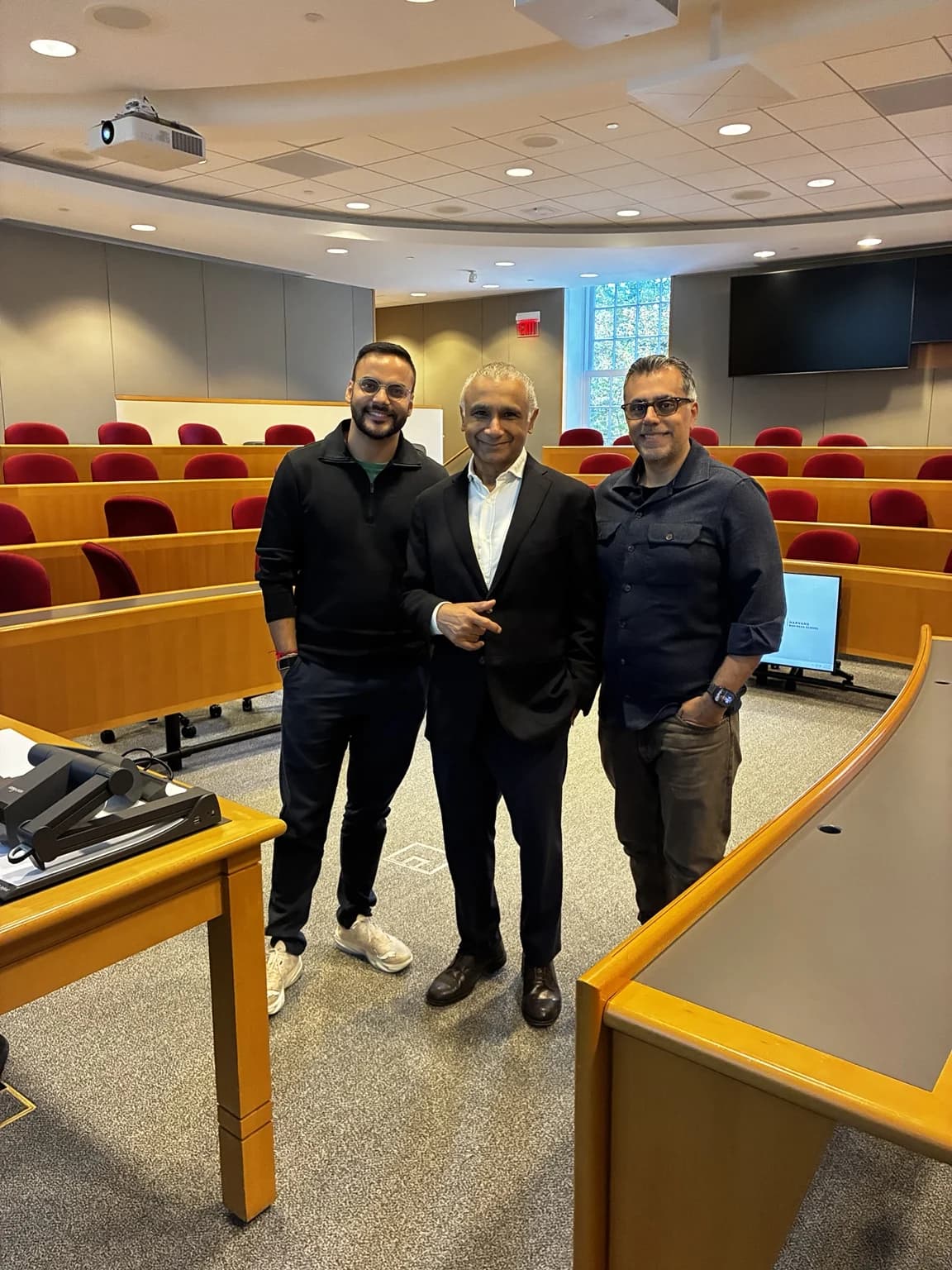
With Prof Ghosh and Vinay at Harvard Business School after the case discussion.
On October 5, I sat in a Harvard Business School classroom for the first time. Prof Ghosh was leading a case discussion involving the AI coworker program I’ve helped build at OneDigital.
It was pretty surreal. Work that has occupied so much of my life was now something a room full of students could critique and pick apart. They were questioning the decisions, debating the tradeoffs, and asking what they would have done differently.
I’m going to write about a few of the questions we debated in that classroom. I want to start with Shelley, because she and I have worked so closely on Ben.
Shelley and I have been tied at the hip as she’s supervised Ben, our benefits AI coworker. Hearing her contribution debated in a Harvard classroom felt a little different from hearing students discuss an abstract management problem. I knew the person. I’d worked alongside her.
Shelley had been one of the company’s top producers before she was asked to focus her attention on Ben and move away from selling. In class, Prof Ghosh asked whether she should have gone on the trip to Morocco that recognized top salespeople that year.
She wasn’t selling herself. But how many people had she helped sell more? Sell better?
You can probably guess my instinct. But the follow-up made the question even more interesting: what about everyone else who contributes to an AI coworker? How do you decide whose contribution counts, and how much?
It raised a bigger question about how we evaluate people.
The work behind Ben
When I say Shelley “supervises” Ben, it’s easy to picture someone checking a few answers and getting back to their day.
That does Shelley a disservice.
A benefits expert can read an answer and notice that something is missing even when every sentence sounds reasonable. They know which exceptions matter. They understand when a general answer needs more context before anyone should act on it.
Getting that judgment into an AI coworker takes work. So does checking whether it holds up when colleagues start asking questions you didn’t anticipate. Shelley also champions Ben across the company and trains people to get more out of it. Making the coworker useful includes helping people learn how to use it.
That’s the work I’ve been involved in with Shelley. Ben needs someone who understands the subject well enough to judge the answers, help improve them, and keep paying attention as the coworker is used.
Moving an expert away from selling changes the contribution we’re asking them to make. It raises a question about what success should look like in that role, and which forms of recognition should reflect it.
We chose an expert because her expertise was valuable. We then needed her to spend some of that expertise helping an AI become useful to other people.
How should that work count when we evaluate her performance?
Individual results are easier to see

Companies have dealt with versions of this for years.
The person who mentors a new colleague. The salesperson who develops an approach the rest of the team uses. The expert everyone calls when a situation gets complicated.
Their contribution extends beyond their own numbers. Sometimes a manager recognizes that. Sometimes it becomes a nice sentence in a review, followed by a conversation about why they missed their target.
AI makes the question harder because it can carry someone’s expertise much further.
If Shelley helps Ben answer a question well, that work can potentially help colleagues long after she’s moved on to something else. They don’t all need to call her individually. Her judgment can inform work she never sees.
That possibility is part of why I’m excited about the program.
It also creates an attribution problem. A colleague may use Ben, apply their own judgment, and get a good result. How much belongs to the colleague? How much to Shelley?
It’s easier to attach someone’s name to a sale than to work that helps a whole team.
If we only recognize the things with an obvious owner, we make it harder for people to justify the work that helps everyone else.
An invitation is only part of the answer
It would be satisfying to end this with “send Shelley to Morocco.”
But an exception for one person doesn’t tell the next expert what to expect when we ask them to supervise a coworker.
Do they still carry the same targets? Will this work count in their review? Who decides whether the coworker is helping enough to justify the time they’re spending on it?
Those are fair questions. If I were signing up to supervise a coworker, I’d want those answers before taking on the responsibility.
I also don’t think building an AI coworker should automatically earn someone recognition. A coworker can attract attention, generate lots of activity, and still make very little difference to anyone’s work. Rewarding every AI project would create its own problems.
So the answer has to include both the contribution and the benefit.
First, make room for the work. Decide what comes off the supervisor’s plate and how their goals change. Some people will supervise a coworker alongside their existing job. Others may move into it as their main responsibility. Either way, we need to be clear about what we’re asking them to deliver.
Second, agree on what a useful coworker would do. Perhaps it helps colleagues prepare better for client conversations, resolve questions faster, or avoid mistakes. The evidence will depend on the role. Chat volume alone won’t settle it.
Third, decide how that contribution will count toward the supervisor’s performance. That could affect goals, recognition, compensation, or some combination. It also needs room for later contributors, because the person who builds the first version won’t necessarily be the only person who makes it valuable.
None of this gives us a neat formula for dividing credit. It does give the expert a clearer deal.
My part in this
I help build and run this program. That means I have a part in making these responsibilities workable.
I can find the right expert, help them build a coworker, and encourage colleagues to use it. But if I haven’t helped make room for the expert’s time, or made their contribution visible to the people evaluating their performance, I’ve left an important part of the job unfinished.
Sitting in that classroom was fascinating partly because the students had the distance to question things that can become familiar when you’re deep in the work.
I’ve spent a lot of time thinking about how Ben should earn more responsibility. Shelley deserves just as much thought about what taking responsibility for Ben means for her.
Before the next expert agrees to supervise an AI coworker, I want us to be clear about how the work will count.
If someone on your team helps an AI make their colleagues better at their jobs, how would you recognize that contribution?
Robin's Notebook
A new entry every couple of weeks. No promotion, no funnel, no manifesto. Just the unfiltered version.
Subscribing opens beehiiv.com in a new tab to confirm. Unsubscribe anytime; I won't share your email.